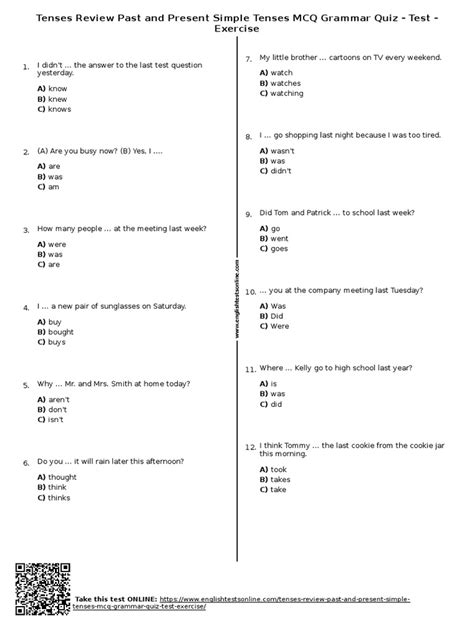
Mastering Present & Past Tenses with iQuizHaving trouble figuring out when to use “go” versus “went,” or “is doing” instead of “has done”? You’re not alone, guys! Understanding
present and past tenses
is absolutely
crucial
for anyone looking to speak, write, or even just comprehend English effectively. It’s the backbone of clear communication, allowing us to accurately describe when actions happen, whether it’s something happening right now, something that happened yesterday, or something that’s been happening for a while. Without a solid grasp of these tenses, conversations can get confusing faster than you can say “tense moment”! That’s where
iQuiz
comes in, acting as your personal grammar coach, ready to transform your understanding from vague to absolutely crystal clear. This incredible tool isn’t just another boring textbook or a series of rote exercises; it’s an interactive, engaging platform designed to make learning grammar, especially the intricate world of tenses, genuinely fun and effective. We’re talking about real, practical application that sticks. Whether you’re a student preparing for an exam, a professional aiming to improve your communication skills, or just someone who loves learning and wants to speak English more confidently, iQuiz is tailored to meet your needs. It breaks down complex rules into manageable, bite-sized pieces, providing immediate feedback and explanations that help solidify your learning. Forget the frustration of not knowing why an answer is wrong; iQuiz tells you, and then helps you practice until you get it right. It helps you distinguish between the subtle differences that often trip up learners, such as when to use the simple past versus the present perfect, or how to correctly use continuous tenses to describe ongoing actions. We’ll explore how iQuiz supports each tense, making sure you not only learn the rules but also internalize them so they become second nature. Get ready to embark on a journey that will not only boost your grammar skills but also significantly enhance your overall English fluency. It’s time to tackle those tenses head-on with a fantastic ally: iQuiz! We’re going to dive deep into each tense, giving you the lowdown on how to master them and how iQuiz is the ultimate secret weapon in your learning arsenal. Prepare to be amazed at how quickly you can start applying these complex grammatical structures in your everyday English.## Unlocking the Power of Present TensesUnderstanding the
present tenses
is your first major step towards fluent English communication, guys. These tenses are all about actions and states that are happening now, regularly, or have a direct connection to the present moment. They form the foundation of everyday conversation and are incredibly versatile. We’ve got four main ones to explore: Simple Present, Present Continuous, Present Perfect, and Present Perfect Continuous. Each has its own unique role and specific contexts where it shines. Mastering these isn’t just about memorizing rules; it’s about understanding the nuances of how English speakers describe the world around them, moment by moment. iQuiz provides an exceptional environment for this by offering targeted exercises that challenge your comprehension and application of each specific tense, giving you a chance to truly internalize the mechanics rather than just mechanically recalling them. It ensures that you aren’t just guessing, but actively learning from your mistakes with clear, concise explanations. Let’s break down each one and see how iQuiz helps you conquer them.### Simple Present Tense: Your Daily English CompanionThe
Simple Present Tense
is arguably one of the most fundamental and frequently used tenses in English. It’s all about actions that happen
regularly
,
habitually
, or are
general truths
and
facts
. Think about your daily routine: “I wake up at 7 AM,” “The sun rises in the east,” or “She works as a teacher.” These are perfect examples of the simple present in action. It’s also used for scheduled events in the near future, like “The train leaves at 8 PM.” For statements, we typically use the base form of the verb (e.g., “I read,” “You play,” “They eat”), but remember that crucial ’s’ for third-person singular subjects (he, she, it): “He reads,” “She plays,” “It eats.” This little ’s’ often trips people up, but it’s a critical marker! For questions and negative statements, we bring in the auxiliary verbs “do” or “does” (again, ‘does’ for third-person singular). So, “Do you like coffee?” or “She doesn’t speak French.”
Common errors
include forgetting the ’s’ for third person singular, misusing “do/does” in questions, or confusing it with the present continuous for ongoing actions. This tense is the workhorse for describing routines, unchanging situations, scientific facts, and general statements of truth. It’s about stability and what is generally true, not necessarily what’s happening at this exact second. For example, if you say “I live in London,” it’s a permanent fact, not something that’s only happening right now.
iQuiz
is a total game-changer for mastering the simple present. It offers specific exercises focusing on correct verb forms, including the tricky third-person ’s,’ and distinguishes between regular actions and actions happening at the moment. You’ll get plenty of practice forming questions and negatives, ensuring you don’t forget those “do” and “does” auxiliaries. The immediate feedback tells you exactly where you went wrong, helping you correct those pesky errors right away. It offers fill-in-the-blank questions, multiple-choice scenarios, and even sentence construction tasks that force you to actively apply the rules. With iQuiz, you’ll drill the simple present until it becomes second nature, allowing you to confidently talk about your habits, facts, and daily life without a second thought. It’s all about building that solid grammatical foundation, and the intuitive design of iQuiz makes it incredibly effective and surprisingly fun.### Present Continuous Tense: What’s Happening Right Now?Alright, guys, next up is the
Present Continuous Tense
, also known as the present progressive. This tense is all about capturing the
now
– actions that are
in progress at this very moment
, or around the present time. Think about what you’re doing right now: “I am reading this article,” or “You are learning about grammar.” It’s formed using the present tense of “to be” (am, is, are) followed by the -ing form of the main verb (the present participle). So, “I
am studying
,” “He
is watching
TV,” “They
are playing
soccer.” Beyond immediate actions, it’s also used for temporary situations, like “She
is living
in Rome for a few months,” or for trends and developing situations, such as “The climate
is changing
rapidly.” Interestingly, it can also be used for future plans that are already arranged, like “We
are meeting
at 7 PM tomorrow.”
Common errors
include forgetting the “to be” verb, using the simple present instead of the present continuous for ongoing actions, or misusing it with stative verbs (verbs that describe states rather than actions, like “know,” “love,” “understand,” which generally aren’t used in continuous forms). It’s crucial to distinguish between “I read a book every day” (simple present, habit) and “I am reading a book right now” (present continuous, ongoing action). This distinction is key to conveying the precise timing of events. The present continuous paints a dynamic picture of what’s unfolding, giving your descriptions a sense of immediacy and temporary duration.
iQuiz
offers a fantastic way to practice and master the present continuous. It presents you with scenarios that clearly delineate when an action is ongoing versus habitual, helping you make the correct choice. You’ll encounter questions that require you to form the correct “to be” + -ing structure, ensuring you don’t drop that essential auxiliary verb. The platform provides examples involving both immediate actions and temporary situations, so you get a feel for the full range of this tense’s usage. Plus, iQuiz helps you identify and avoid the trap of using stative verbs in continuous forms, a common mistake for English learners. Its interactive exercises, from sentence completion to choosing the best verb form, are designed to reinforce the rules through practical application. By getting instant feedback, you can immediately correct your understanding and solidify your grasp of this dynamic tense, making your descriptions of current events much more accurate and natural.### Present Perfect Tense: Bridging Past and PresentThe
Present Perfect Tense
is where things get a little more interesting, guys, as it truly
bridges the gap
between the past and the present. It describes actions that started in the past but either
continue into the present
, have
just finished
, or whose
effects are still relevant now
. The key takeaway here is the connection to the present. It’s formed using “has” or “have” (depending on the subject) plus the past participle of the main verb. For example, “I
have lived
here for five years” (still living here), “She
has just finished
her homework” (finished recently, effect is she’s free now), or “They
have seen
that movie before” (the experience is relevant now). This tense is often used with time expressions like “for,” “since,” “already,” “yet,” “never,” and “ever.” One of the biggest
common errors
is confusing the present perfect with the simple past. Remember, the simple past focuses on a finished action at a specific time in the past (e.g., “I
went
to Paris last year”), while the present perfect emphasizes the link to the present or the experience itself (e.g., “I
have been
to Paris multiple times” – the experience is relevant to my current knowledge/status). It’s not about
when
it happened, but
that
it happened and its current relevance. For example, “I have lost my keys” implies they are still lost now, whereas “I lost my keys yesterday” refers to a specific past event. Understanding this distinction is absolutely crucial for clear communication. The present perfect allows you to talk about experiences, achievements, and changes over time, without necessarily pinpointing an exact moment.
iQuiz
provides invaluable practice for differentiating between the present perfect and simple past, a notorious sticking point for many learners. It offers exercises that challenge you to choose the correct tense based on context clues like time expressions (“for three years,” “last week”). You’ll get plenty of opportunities to form sentences using the correct “have/has” + past participle structure, making sure you nail those irregular past participles (e.g., “go-went-gone,” “see-saw-seen”). The immediate feedback helps you understand why one tense is appropriate over another, clarifying the subtle but significant differences. Through targeted practice, iQuiz helps you internalize when to use the present perfect to describe life experiences, recent events, or actions that continue up to the present, making your English sound much more natural and precise. It’s a fantastic way to cement your understanding of this incredibly useful, yet often tricky, tense.### Present Perfect Continuous Tense: Duration in ActionAlright team, let’s tackle the
Present Perfect Continuous Tense
, which is perfect for describing actions that started in the past,
have continued up until now
, and are
still ongoing
or have
just recently stopped
with observable results. It really emphasizes the
duration
of an activity. The structure is “has/have been” + the -ing form of the main verb. For instance, “I
have been studying
English for two hours” (meaning I started two hours ago and I’m still studying). Or, “She
has been working
on that project all day” (started in the morning, still working). It’s often used with “for” and “since” to specify the duration or starting point. We also use it to explain a present result: “His eyes are red because he
has been crying
” (the crying just stopped, but the effect is visible now). The main
common error
is confusing it with the present perfect simple. While both connect past and present, the present perfect simple focuses on the
completion
or
result
of an action (e.g., “I
have read
the book” – the book is finished), whereas the present perfect continuous emphasizes the
activity
itself and its duration (e.g., “I
have been reading
the book” – I’m still in the process of reading it). Another point of confusion can be using it when the action is clearly finished with no present connection, which would call for the past continuous or simple past. This tense is fantastic for explaining the background or cause of a current situation, or for expressing how long an ongoing activity has lasted. It adds a layer of depth to your descriptions, indicating not just that something happened, but for how long it was happening, right up to the present moment.
iQuiz
is incredibly effective for distinguishing the present perfect continuous from other tenses. It provides a plethora of exercises where the context clearly dictates the need for duration and ongoing action. You’ll practice constructing sentences using the correct “have/has been” + -ing structure, reinforcing the form until it becomes second nature. The platform’s scenarios often highlight the subtle differences between this tense and the present perfect simple, helping you choose the most appropriate tense to convey your intended meaning, particularly concerning the emphasis on ongoing activity versus completed results. For example, iQuiz might present a situation and ask whether “I have played tennis” or “I have been playing tennis” is more suitable, based on the presence of a time duration or an emphasis on the activity’s continuity. The instant feedback on iQuiz illuminates your mistakes and provides clear explanations, making it easier to grasp these finer points of English grammar. This targeted practice ensures you develop a strong intuitive understanding of when and how to use the present perfect continuous to accurately describe prolonged actions that started in the past and continue or recently finished in the present.## Navigating the Nuances of Past TensesNow, let’s shift gears and dive into the world of
past tenses
, guys. These are absolutely essential for telling stories, recounting events, and discussing anything that happened before the present moment. Just like the present tenses, we have four main past tenses, each with its own specific role: Simple Past, Past Continuous, Past Perfect, and Past Perfect Continuous. Mastering these will give your English descriptions a sense of chronology and allow you to accurately paint a picture of events that have already transpired. They are not just about saying
what
happened, but often
when
it happened in relation to other events, adding richness and precision to your narratives. Understanding these tenses is key to differentiating between a single, completed action and an action that was ongoing, or an action that occurred before another past action. iQuiz is designed to guide you through these intricacies, providing clear examples and interactive exercises that solidify your understanding. It helps you recognize the subtle contextual clues that indicate which past tense is most appropriate, making sure you don’t just memorize rules, but truly comprehend their application in real-world sentences. Let’s break them down.### Simple Past Tense: Telling Your StoriesThe
Simple Past Tense
is your go-to for talking about actions that
started and finished at a specific time in the past
. It’s straightforward and incredibly useful for recounting events, telling stories, and describing historical facts. Think about it: “I
ate
breakfast an hour ago,” “She
visited
Paris last year,” or “They
finished
their project yesterday.” The key here is that the action is completely done, over, and has a clear end point in the past, often indicated by time expressions like “yesterday,” “last week,” “in 2010,” or “three days ago.” For most regular verbs, you just add “-ed” to the base form (e.g., “walked,” “played,” “called”). However, you’ve got to remember the
irregular verbs
, which don’t follow this pattern and often change their form entirely (e.g., “go” becomes “went,” “see” becomes “saw,” “eat” becomes “ate”). This is a major area for
common errors
– memorizing these irregular forms is absolutely vital! For questions and negative statements, we use the auxiliary verb “did” (the past form of “do”) along with the base form of the main verb: “Did you go to the party?” or “She didn’t finish her work.” It’s a common mistake to use “did” with an -ed verb (e.g., “Did you went?”), so be careful there! The simple past is all about definite past events, giving your narrative a clear timeline of completed actions. It’s the foundational tense for historical accounts, personal anecdotes, and straightforward reporting of past incidents.
iQuiz
is a lifesaver for mastering the simple past, especially with those tricky irregular verbs. It provides tons of exercises specifically designed to help you practice and memorize the correct past tense forms, both regular and irregular. You’ll encounter fill-in-the-blank questions that require you to recall the correct verb form, multiple-choice options that test your recognition, and sentence-building tasks that push you to apply the rules actively. The immediate feedback system is fantastic; if you get an irregular verb wrong, iQuiz will tell you the correct form and help you drill it. It also offers focused practice on forming questions and negatives correctly using “did,” ensuring you don’t make the common mistake of double-past-tensing. By repeatedly exposing you to the correct usage in various contexts, iQuiz helps solidify your understanding of when and how to use the simple past tense effectively, making your past narratives coherent and accurate. It turns the daunting task of irregular verb memorization into an engaging, interactive challenge.### Past Continuous Tense: Actions in Progress in the PastAlright, listen up, guys! The
Past Continuous Tense
(also known as the past progressive) is super helpful for describing actions that were
ongoing at a specific point or period in the past
. Think of it as painting a backdrop for other past events. It’s formed using the past tense of “to be” (was/were) plus the -ing form of the main verb. For example, “I
was reading
a book when she called” (my reading was ongoing when the call interrupted it). Or, “They
were watching
TV all evening.” It’s often used to show that one action was in progress when another shorter action interrupted it, or to describe two simultaneous ongoing actions in the past. Keywords like “while” and “as” are frequently associated with this tense. “While I
was studying
, my phone rang.”
Common errors
include confusing it with the simple past, especially when describing simultaneous actions, or misusing “was/were” with singular/plural subjects. Remember, “was” for I/he/she/it and “were” for you/we/they. This tense provides context and atmosphere for past events; it sets the scene. If you say “I walked down the street,” it’s a completed action. But “I
was walking
down the street” implies you were in the middle of that action, perhaps when something else happened. It emphasizes the duration or the unfinished nature of an action at a particular point in the past. It’s great for building a narrative, showing not just what happened, but what
was happening
at a given moment, providing a sense of unfolding events.
iQuiz
offers excellent interactive scenarios that help you master the past continuous. You’ll get practice with distinguishing between an ongoing background action and a sudden interrupting action, a common use case for this tense. For instance, iQuiz might give you two events and ask you to combine them using the past continuous and simple past correctly (e.g., “I was eating dinner when the lights went out”). It also focuses on proper subject-verb agreement with “was” and “were,” ensuring you pair them correctly with singular and plural subjects. The exercises are designed to build your confidence in constructing sentences with the correct “was/were” + -ing structure. By providing immediate feedback and detailed explanations, iQuiz clarifies the nuances between the past continuous and simple past, ensuring you use each tense accurately to convey the precise timing and relationship of events in your past narratives. It truly helps you paint a vivid picture of past moments.### Past Perfect Tense: The Event Before the EventAlright, guys, let’s talk about the
Past Perfect Tense
– this one is your go-to for clarity when you’re talking about
multiple events in the past
, helping you establish which action happened
earlier
than another past action. It’s like a time machine within your sentences! It’s formed using “had” plus the past participle of the main verb (e.g., “had gone,” “had seen,” “had eaten”). The crucial function here is to describe an action that was completed
before another action in the past
. For example, “By the time I arrived, the movie
had already started
.” Here, “the movie starting” happened before “I arrived.” Another example: “She
had finished
her work before she went to bed.” The finishing happened first. It’s super useful with time conjunctions like “before,” “after,” “by the time,” and “when.” A major
common error
is using the simple past when the past perfect is needed to clarify the sequence of events. If both actions are just in the simple past, the listener might assume they happened sequentially or simultaneously. The past perfect explicitly states one action was completed prior to another past action, providing a chronological anchor. Without it, your storytelling can become ambiguous, making it harder for your audience to follow the order of events. This tense is essential for complex narratives, ensuring that your listeners or readers understand the exact order in which things unfolded. It clarifies that a past action was already a
done deal
at a specific past point or when another past action occurred.
iQuiz
offers fantastic practice for mastering the past perfect, particularly in scenarios involving a sequence of past events. It presents exercises where you need to correctly sequence actions, choosing the past perfect for the earlier event and the simple past for the later one. For instance, you might be given two simple past sentences and tasked with combining them using the past perfect to show precedence (e.g., “I ate lunch. Then I went to the store.” -> “I
had eaten
lunch before I went to the store.”). The platform helps you practice the “had” + past participle structure, including those irregular past participles that are so crucial here. The immediate feedback is invaluable, helping you understand the chronological relationship between different past actions and why the past perfect is necessary for clarity. By working through diverse examples, iQuiz solidifies your ability to use the past perfect effectively, making your complex past narratives clear, logical, and easy for anyone to follow. It’s truly a powerful tool for sophisticated English communication.### Past Perfect Continuous Tense: Sustained Actions Before a Past PointOkay, last but not least in our past tense journey, let’s explore the
Past Perfect Continuous Tense
, guys. This tense is a bit of a mouthful, but it’s incredibly useful for describing an action that
started in the past, continued for some duration, and then stopped at or just before another point in the past
. Like its present perfect continuous cousin, it really emphasizes the
duration
of the activity. It’s formed with “had been” plus the -ing form of the main verb (e.g., “had been studying,” “had been working,” “had been waiting”). For example, “She
had been waiting
for two hours before the bus finally arrived.” Here, the waiting started earlier and continued right up until the bus arrived. Or, “The ground was wet because it
had been raining
all morning.” The raining stopped (or ended just before the observation), but it had been ongoing for a period. This tense is often used with “for” and “since” to specify the duration or starting point of the longer, preceding action. A common
error
is to confuse it with the past perfect simple. The key difference lies in the emphasis: the past perfect simple focuses on the
completion
of an action before another past point (e.g., “I
had read
the book by midnight”), while the past perfect continuous highlights the
ongoing nature
and
duration
of the action before that past point (e.g., “I
had been reading
the book all evening”). It’s all about providing context and explaining the cause or background of a past situation, stressing that an activity was in progress for a significant period leading up to another past event. It truly allows for very detailed and nuanced storytelling, painting a clear picture of what led up to a particular past moment.
iQuiz
offers excellent targeted exercises to help you grasp the intricate nature of the past perfect continuous. It provides scenarios where the duration of an action preceding another past event is crucial to the meaning. You’ll practice forming sentences with the correct “had been” + -ing structure, solidifying this complex form. For instance, iQuiz might present a situation like “He was tired because…” and ask you to complete it using the past perfect continuous, prompting you to think about an ongoing action that led to his fatigue (e.g., “…he
had been running
a marathon.”). The platform’s immediate feedback helps you differentiate between the past perfect continuous and other past tenses, especially the past perfect simple, by highlighting when the emphasis on duration and ongoing activity is required. Through these interactive challenges, iQuiz builds your confidence in using this advanced tense to articulate complex sequences of events and their underlying causes, making your narratives much more sophisticated and precise.## How iQuiz Makes Learning Tenses a BreezeAlright, guys, now that we’ve broken down all the nitty-gritty details of
present and past tenses
, let’s talk about the
real star of the show
:
iQuiz
! This isn’t just another boring grammar app; it’s a dynamic, interactive learning platform designed specifically to make mastering these complex tenses not just achievable, but genuinely
enjoyable
. Seriously, who thought grammar could be fun? iQuiz does! The beauty of iQuiz lies in its multi-faceted approach to learning. First off, it’s packed with an incredible variety of
interactive exercises
. We’re not talking about endless multiple-choice questions here, though those are certainly present and helpful. iQuiz offers fill-in-the-blank challenges, sentence reordering tasks, error identification, and even scenarios where you have to construct full sentences using the correct tense. This diversity keeps your brain engaged and ensures you’re applying the rules in various contexts, not just passively recognizing them. Each exercise is carefully crafted to target specific aspects of each tense, from regular and irregular verb forms to the subtle differences in meaning that distinguish one tense from another. This means you get comprehensive practice that covers all the bases, ensuring no tricky rule slips through the cracks.Second, and this is a massive plus, iQuiz provides
instant and constructive feedback
. Ever tried to learn grammar from a textbook, only to find you’ve been practicing a mistake for an hour? Not with iQuiz! The moment you submit an answer, you know if you’re right or wrong. But it doesn’t stop there. If you make a mistake, iQuiz doesn’t just say “incorrect”; it often provides a clear, concise explanation of
why
your answer was wrong and
what the correct rule is
. This immediate clarification is absolutely vital for effective learning, preventing the reinforcement of errors and solidifying your understanding right then and there. It’s like having a personal tutor constantly by your side, guiding you.Third, the platform excels at
tracking your progress
. One of the most motivating things in learning is seeing how far you’ve come, right? iQuiz keeps a detailed record of your performance across different tenses and exercise types. You can easily see which tenses you’ve mastered, where you’re consistently doing well, and, more importantly, which areas still need a bit more attention. This personalized insights feature allows you to focus your efforts strategically, ensuring you spend your time on what truly matters for your improvement. It helps you identify your personal “ghosts” in grammar and then offers specific exercises to exorcise them! This kind of targeted practice is incredibly efficient and prevents you from wasting time on concepts you already understand.Fourth, iQuiz offers
personalized learning pathways
. Based on your performance data, the platform can often suggest exercises or lessons that are most relevant to your specific needs. If you’re consistently struggling with the present perfect versus simple past, iQuiz will guide you towards more practice in that area. This adaptive learning approach ensures that your learning experience is tailored to your unique strengths and weaknesses, making every minute you spend on the app maximally productive. It’s not a one-size-fits-all solution; it adapts to
your
learning journey.Finally, and perhaps most importantly, iQuiz fosters
motivation and confidence
. The gamified elements, the clear progress tracking, and the positive reinforcement from correct answers create a truly engaging and less intimidating learning environment. When you start seeing tangible improvements and understanding complex grammatical structures that once seemed daunting, your confidence in using English skyrockets. This renewed confidence encourages you to practice more, speak more, and write more, creating a virtuous cycle of learning and improvement. Ultimately, iQuiz doesn’t just teach you grammar rules; it helps you build an intuitive understanding of English tenses, empowering you to communicate more clearly, precisely, and confidently. It’s truly a game-changer for anyone serious about mastering English grammar. So, if you’re ready to ditch the confusion and embrace clarity, give iQuiz a try – you won’t regret it!## Pro Tips for Tense MasteryOkay, guys, you’ve got iQuiz, you understand the tenses, but how do you really
lock in
that knowledge and make it stick? Here are some pro tips to help you move from simply understanding to truly
mastering present and past tenses
and beyond! Remember, consistent effort and diverse approaches are your best friends in this journey. First and foremost,
practice regularly
. This isn’t a one-and-done kind of deal. Grammar, like any skill, needs continuous reinforcement. Dedicate a short, consistent amount of time each day or a few times a week to work with iQuiz. Even just 15-20 minutes of focused practice can make a huge difference over time compared to cramming for hours once a month. Regular exposure helps new concepts solidify in your memory and makes recalling the correct tense second nature. Think of it like building muscle; you can’t hit the gym once and expect to be strong forever. Consistent workouts are key, and iQuiz provides the perfect platform for those daily grammar workouts.Second,
read widely and actively
. Don’t just skim! When you’re reading books, articles, news, or even social media posts in English, pay close attention to how native speakers use tenses. Notice the specific time markers that trigger certain tenses (e.g., “last night” for simple past, “for three years” for present perfect). Try to identify why a particular tense was chosen over another. This active reading helps you see the rules in context and understand their practical application, which is far more effective than just memorizing definitions. Reading exposes you to a vast array of examples that reinforce what you learn in iQuiz. Underline or make a mental note of sentences that use tenses in a way that seems particularly clear or interesting to you.Third, and this is a big one:
speak English as much as possible
. It’s one thing to get answers right in an exercise; it’s another to produce them spontaneously in conversation. Don’t be afraid to make mistakes when you’re speaking. In fact, embrace them! Each mistake is a learning opportunity. The more you try to use the different tenses in real-time conversation, the faster you’ll develop an intuitive feel for them. Find language exchange partners, join English speaking clubs, or even talk to yourself in English! The goal is to move from consciously applying rules to effortlessly using the correct tenses. Speaking forces your brain to retrieve and apply grammar rules under pressure, which is excellent training for fluency.Fourth,
don’t be afraid of mistakes; learn from them
. As mentioned, mistakes are inevitable, especially when learning something as complex as English tenses. The key is your attitude towards them. Instead of getting discouraged, view mistakes as diagnostic tools. When iQuiz tells you you’ve made an error, take a moment to understand
why
. Read the explanation, internalize it, and then apply that new understanding to subsequent exercises. Don’t just rush through. This reflective approach to learning is incredibly powerful. Also, if you notice yourself making the same mistake repeatedly in conversation, make a note of it and deliberately practice that specific tense or rule in iQuiz.Finally,
review and revisit
. Grammar rules can sometimes feel like they fade over time if not regularly reinforced. Periodically revisit earlier lessons or practice modules in iQuiz, especially for tenses you found particularly challenging. A quick review can refresh your memory and prevent knowledge from slipping away. Consistency, active engagement, and a positive attitude toward learning are your secret weapons for achieving true mastery of English tenses. Combine these tips with the power of iQuiz, and you’ll be speaking and writing with confidence and precision in no time!## Conclusion: Your Journey to Fluency Starts Now!Alright, guys, we’ve covered a lot of ground today, diving deep into the fascinating and sometimes tricky world of
present and past tenses
in English grammar. We’ve explored the nuances of the Simple Present, Present Continuous, Present Perfect, and Present Perfect Continuous, understanding how each describes actions and states in relation to the
now
. Then, we journeyed into the past, unraveling the Simple Past, Past Continuous, Past Perfect, and Past Perfect Continuous, learning how to accurately recount events, establish chronologies, and describe ongoing actions that occurred before the present moment. From describing daily habits to narrating complex sequences of historical events, a solid grasp of these tenses is not just helpful; it’s absolutely
foundational
for effective and clear communication in English. It’s the difference between merely being understood and truly conveying your message with precision and confidence. You see, the power of accurate tense usage allows you to tell your stories, express your ideas, and engage in conversations without ambiguity, making your English sound natural and sophisticated.However, simply reading about these tenses isn’t enough, right? This is where
iQuiz
truly shines as your ultimate companion on this journey to grammatical mastery. We’ve seen how its interactive exercises, immediate and constructive feedback, personalized progress tracking, and adaptive learning pathways transform what can often be a daunting subject into an engaging and highly effective learning experience. iQuiz doesn’t just teach you the rules; it helps you internalize them through consistent, varied practice, ensuring that you can recall and apply the correct tenses spontaneously and accurately in real-world scenarios. It takes the guesswork out of grammar and replaces it with informed understanding, building your confidence one correct answer at a time. It’s an empowering tool that turns those frustrating moments of uncertainty into clear learning opportunities.The journey to English fluency is an ongoing one, but mastering
present and past tenses
is a monumental leap forward. By combining the structured, supportive learning environment of iQuiz with the pro tips we discussed – regular practice, active reading, speaking English often, learning from mistakes, and consistent review – you are setting yourself up for incredible success. So, don’t wait another moment! Embrace the challenge, lean on iQuiz, and watch as your ability to communicate in English transforms. Your journey to speaking, writing, and understanding English with greater precision, clarity, and confidence starts right now. Go forth and conquer those tenses, guys – you’ve got this, and iQuiz is here to help you every step of the way!
