Wimbledon 2008: Roger Federer’s Historic Final Showdown\n\n## The Road to the Final: Federer’s Dominance\n\nAlright guys, let’s rewind the clock to Wimbledon 2008, a tournament that saw
Roger Federer
, the undisputed King of Grass, marching relentlessly towards what everyone thought would be his unprecedented sixth consecutive Wimbledon title. Coming into this championship, Federer wasn’t just a great player; he was an absolute phenomenon, having dominated the hallowed greens of the All England Club like no one before him in the Open Era. Imagine the pressure, the sheer weight of expectation on his shoulders. He had won five
consecutive
Wimbledon crowns from 2003 to 2007, a feat that cemented his status as a living legend. Each year, he seemed to elevate his game, showcasing that effortless grace, powerful serve, and sublime touch that made him virtually unbeatable on grass. His path to the 2008 final was, by most standards, typical Federer dominance. He wasn’t dropping sets left and right; instead, he was dispatching opponents with a cool, collected efficiency that bordered on surgical.\n\nThe first few rounds saw him easing into the tournament rhythm, finding his footing on the pristine courts. Opponents like Dominik Hrbaty, Robin Söderling, Marc Gicquel, and Lleyton Hewitt fell one after another, often in straight sets, unable to penetrate his serve or withstand his all-court game. You know, it was like watching a master painter at work – every stroke deliberate, every move precise. As the tournament progressed, the competition naturally stiffened, but Federer seemed unfazed. In the quarterfinals, he faced off against
Mario Ančić
, a player who had actually beaten him at Wimbledon back in 2002. But this was a different Federer, a man possessed by the drive for history. He handled Ančić comfortably, again in straight sets, showcasing his incredible consistency and mental fortitude. Then came the semifinals, a crucial hurdle against
Marat Safin
, a mercurial talent capable of brilliance. While Safin pushed him in moments, Federer’s class shone through, securing his spot in yet another Wimbledon final. This consistent performance throughout the tournament wasn’t just about winning; it was about sending a clear message:
he was here to defend his kingdom
. The air was thick with anticipation, everyone wondering if anyone could truly stop him from achieving that historic sixth title. His serve, his forehand, his incredible movement – every aspect of his game was firing, and he looked
invincible
. The sheer quality of his tennis during these early rounds set the stage perfectly, making the final showdown even more dramatic, because who could possibly challenge a player in such sublime form? He hadn’t just reached the final; he had
earned
it with a display of tennis mastery that only Roger Federer could deliver. His journey was a masterclass in staying focused, managing pressure, and elevating his game precisely when it mattered most, setting the stage for what would become an unforgettable moment in sports history.\n\n## The Stage is Set: Federer vs. Nadal – A Rivalry for the Ages\n\nNow, let’s talk about the main event, the showdown that defined an era:
Roger Federer
against
Rafael Nadal
. Guys, this wasn’t just any final; it was the ultimate clash of titans, a truly epic chapter in perhaps the greatest rivalry tennis has ever seen. Imagine the scene: Centre Court at Wimbledon, packed to the rafters, buzzing with an electric energy you could practically taste. On one side, you had Federer, the elegant, five-time defending champion, aiming for an unprecedented sixth straight title. He was the undisputed master of grass, a balletic player whose game was perfectly suited for the fast, low-bouncing courts. His attacking style, his serve-and-volley tactics, and his incredible slice all made him formidable on this surface. But on the other side, there was
Rafael Nadal
, the “King of Clay,” a powerhouse from Mallorca who, up until then, had dominated on the slower, red dirt courts, winning four consecutive French Open titles. He was a force of nature, known for his relentless intensity, incredible athleticism, and heavy topspin forehand that could make even Federer uncomfortable.\n\nLeading up to this final, their rivalry had already reached legendary status. They had met in the previous two Wimbledon finals (2006 and 2007), with Federer emerging victorious in both, though the 2007 final was a tight five-setter that hinted at Nadal’s growing prowess on grass. But 2008 felt different. Nadal had just absolutely
annihilated
Federer at the French Open final, giving him one of the most lopsided Grand Slam final defeats of his career. That victory wasn’t just a win; it was a statement. Nadal was no longer just a clay-court specialist; he was evolving, adapting his game, and posing a serious threat on all surfaces. He had even won Queen’s Club, a grass-court warm-up tournament, just weeks before Wimbledon, signaling his readiness. So, when these two giants stepped onto Centre Court, it wasn’t just about the Wimbledon title; it was about supremacy. Federer was fighting for his legacy, for that elusive sixth consecutive title that would solidify his place as perhaps
the greatest
grass-court player ever. Nadal was fighting to break Federer’s stranglehold, to prove that his dominance wasn’t limited to clay, and to finally claim a Wimbledon title, something no one had really expected from a player so synonymous with dirt. The contrast in their styles was stark and beautiful to watch: Federer’s graceful, artistic precision against Nadal’s raw power, relentless defense, and sheer willpower. The crowd was split, but united in anticipation. Everyone knew this wasn’t going to be just another tennis match. This was personal. This was history in the making. The air was charged with the weight of their previous encounters, the recent French Open thrashing still fresh in everyone’s minds, and the tantalizing possibility that the torch might finally be passed. The stage was indeed perfectly set for what would become an unforgettable spectacle, a true tennis opera played out on the grandest stage.\n\n## The Epic Battle: A Match for the History Books\n\nAlright, deep breath everyone, because we’re diving into the match itself – the
2008 Wimbledon Final
between
Roger Federer
and
Rafael Nadal
. This wasn’t just a tennis match; it was a five-set, nearly five-hour epic that transcended sport and became a defining moment for a generation of fans. If you ask anyone who watched it, they’ll tell you it was
unforgettable
, possibly the greatest tennis match ever played. From the very first ball, the tension was palpable. Nadal, fueled by his French Open victory and a fierce desire to dethrone the king, came out firing. He clinched the first two sets, 6-4, 6-4, shocking many and putting Federer in a truly precarious position, one he hadn’t faced in a Wimbledon final in years. Nadal’s forehand, loaded with heavy topspin, was bouncing high, troubling Federer’s backhand, and his relentless defense meant very few points came easy. It felt like Nadal was everywhere, retrieving everything, hitting winners from impossible angles. Guys, it was brutal to watch if you were a Federer fan, because it seemed like his reign was crumbling right before our eyes.\n\nBut then, as only champions do,
Federer
dug deep. He found a new gear, showcasing the kind of mental toughness that defines legends. He fought back to take the third set in a tie-break, 7-6(5), and then, defying all expectations, leveled the match by winning the fourth set, also in a tie-break, 7-6(8), after saving two championship points!
Can you believe it?
Saving championship points against
Nadal
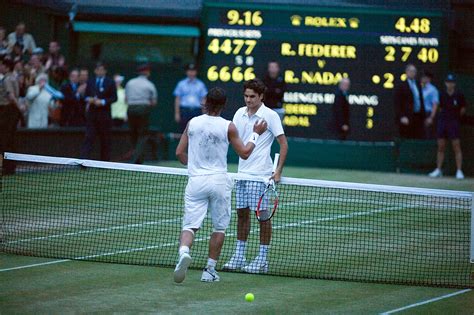
on Centre Court! These tie-breaks were pure drama, filled with incredible rallies, jaw-dropping winners, and Federer’s serves finding their mark just when he needed them most. The crowd was on its feet, roaring with every point, utterly captivated. And if the drama wasn’t enough, Mother Nature decided to join the party, bringing multiple rain delays that only heightened the suspense, forcing the players to leave the court, cool down, and then restart the intensity all over again. Each time they returned, the level of play remained incredibly high. As the match stretched into the fading light, the fifth set became a war of attrition, a test of wills and endurance. No tie-break in the fifth set at Wimbledon meant it would go on until one player had a two-game advantage. Both players held serve heroically, pushing each other to the absolute brink. Federer’s serve saved him time and again, while Nadal’s relentless groundstrokes continued to pound away. The score crept up: 2-2, 3-3, 4-4, 5-5, 6-6, 7-7, and so on. The light was getting dimmer, the crowd was hushed in disbelief and awe, and the tension was almost unbearable. Finally, after four hours and forty-eight minutes of mind-blowing tennis, with the score at 7-7 in the fifth, Nadal broke Federer’s serve. He then served for the championship, holding his nerve to win it 9-7 in the final set. The final score was 6-4, 6-4, 6-7(5), 6-7(8), 9-7. It was an absolutely brutal, beautiful, and utterly
historic
victory for Nadal, and a heartbreaking, yet valiant, defeat for Federer. Every single shot, every missed opportunity, every heroic save – it was all etched into the memories of those who witnessed it. This match wasn’t just about who won or lost; it was about two incredible athletes pushing the boundaries of what was thought possible, leaving everything they had on the court, and giving us a spectacle that will truly never be forgotten.\n\n## The Aftermath and Legacy: A Defining Moment\n\nThe moment
Rafael Nadal
finally served out that championship point at
Wimbledon 2008
, the roar from Centre Court was deafening, a mix of pure elation for Nadal and respectful applause for
Roger Federer
. It was a moment of profound change in tennis history. Nadal sank to the grass in disbelief, tears welling up, having finally achieved his lifelong dream of winning Wimbledon and, in doing so, dethroning the five-time defending champion. For Federer, it was a rare taste of defeat on his beloved grass, a heartbreaking end to his quest for a sixth consecutive title. Yet, in typical Federer fashion, he was gracious in defeat, offering a warm embrace at the net and acknowledging Nadal’s incredible performance. The images of Nadal celebrating, climbing into the player’s box to hug his family and coach, and Federer standing stoically, accepting the runner-up plate, are iconic. They represent the passing of a torch, or at least a powerful challenge to the existing order.\n\nThis match wasn’t just a win for Nadal; it was a turning point for
their rivalry
and for the sport itself. Before 2008, Federer was clearly the dominant force, especially outside of clay. This victory by Nadal shattered the perception that he was merely a clay-court specialist. It proved, definitively, that he could conquer
any surface
with his sheer will and ever-improving all-court game. It propelled him to the World No. 1 ranking soon after, breaking Federer’s record reign at the top. For Federer, while a devastating loss, it also humanized him in a way, showing his vulnerability and incredible fighting spirit even in defeat. It set the stage for years of continued rivalry, pushing both players to new heights as they chased records and Grand Slams. Many tennis experts and fans immediately hailed it as the
greatest tennis match ever played
, and honestly, guys, it’s hard to argue with that. The quality of tennis, the stakes, the sheer drama, the back-and-forth momentum swings, the rain delays, the fading light, and the fact that it involved two of the sport’s all-time legends at the peak of their powers – all these elements combined to create something truly magical. Its impact was profound. It ignited a new level of interest in tennis, drawing in casual fans who were captivated by the gladiatorial battle. It also redefined what was possible in terms of physical and mental endurance in the sport. Players looked at Nadal’s transition from clay to grass and realized that with enough dedication, their games could adapt too. The legacy of Wimbledon 2008 is not just about Nadal’s victory or Federer’s loss; it’s about the elevation of a rivalry into something mythical, a clash that pushed both men to be better, to innovate, and to keep challenging each other for years to come. It’s a testament to incredible sportsmanship, fierce competition, and the timeless beauty of tennis when played at its absolute highest level. It truly redefined the landscape of men’s professional tennis, setting a benchmark for epic encounters.\n\n## Why Wimbledon 2008 Still Resonates Today\n\nSo, why, after all these years, does the
Wimbledon 2008 final
still hold such a special place in our hearts and minds? Why do we still talk about
Roger Federer
and
Rafael Nadal’s
epic showdown with such reverence? Well, guys, it’s because that match wasn’t just a tennis game; it was a masterpiece of human endeavor, a vivid display of what happens when two sporting titans push each other to their absolute limits. It transcended the boundaries of sport, becoming a cultural touchstone that speaks to themes of resilience, rivalry, and the relentless pursuit of greatness. First off, let’s be real, it was simply
exquisite tennis
. The quality of play was off the charts. Both Federer and Nadal were at the very peak of their powers, showcasing an incredible array of shots, unmatched athleticism, and tactical genius. Every point felt like a mini-drama, a testament to their skills. You had Federer’s silky smooth serve and forehand battling against Nadal’s raw power, incredible topspin, and never-say-die defense. It was a stylistic clash that was, frankly,
beautiful
to behold.\n\nBeyond the technical brilliance, the match had an incredible narrative arc. Federer, the seemingly invincible champion, was challenged by Nadal, the hungry young lion trying to conquer his rival’s kingdom. The ebb and flow of the match, with Nadal taking an early lead, Federer staging a heroic comeback, and the dramatic fifth set in the fading light – it was like a perfectly scripted movie, only it was real. This human element, the sheer
drama
of it all, is what keeps it alive in our collective memory. It was also a defining moment for the
Federer-Nadal rivalry
. Before this match, Federer had a clear edge in Grand Slam finals outside of Roland Garros. This victory by Nadal leveled the playing field and proved that their rivalry was not just about clay versus grass, but about two all-time greats who could win anywhere. It solidified their status as the two dominant forces in tennis for years to come, inspiring countless debates about who was truly the GOAT (greatest of all time). The sportsmanship displayed by both players, even in such a fiercely contested battle, also adds to its legendary status. There was immense respect between them, a recognition of each other’s greatness, which elevated the entire spectacle. It taught us that intense competition doesn’t have to mean animosity; it can mean mutual admiration and pushing each other to achieve more. Furthermore, Wimbledon 2008 serves as an inspiration for athletes and aspiring players everywhere. It demonstrates the importance of never giving up, fighting for every point, and maintaining mental fortitude under extreme pressure. Nadal’s relentless pursuit and Federer’s incredible comeback attempts are lessons in perseverance. It reminds us that greatness isn’t just about winning; it’s about how you play, how you compete, and the respect you earn. It’s a timeless example of sports at its absolute best, a match that will forever be etched in the annals of tennis history and continue to captivate new generations of fans. It’s
the
benchmark for an epic tennis encounter, showcasing the very essence of what makes sports so compelling and unforgettable.
